Innovations in Research Presentations at Academic Conferences
Modern technology has made it possible to expand the features of your conference poster. While printed posters are still effective and the standard at academic conferences, there are new ways to integrate digital features to better engage with your audience. Not only that, but these innovative components improve the accessibility of your research presentation.
In addition, interactive and multimedia elements are keeping audiences engaged and presenting opportunities for follow up after the conference. These innovations help research presentations stand out, which is important when posters are required to apply the same standards. It's not about just captivating your audience for a few minutes, but also ensuring they want to continue learning about you and your research.
Here, we'll look at a few ways you can expand the possibilities of communication and knowledge sharing with your conference poster.
An overview of the basics of research presentations
Research presentations are succinct summaries of a research paper. They are meant to express the important parts of a study in a short and easy-to-understand way. Much like an abstract, they take the viewer on a journey through the process, from the reason for conducting the study, to the methods, the results, and conclusions.
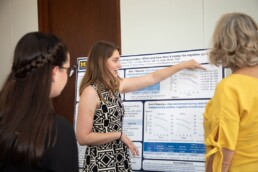
Most presentations take the form of a conference poster. These are visual aids for your summaries. Usually on a large white canvas, they contain text and graphics that pair with a verbal presentation. Ultimately, they should be visible from a few feet away and understandable even if the poster is unattended.
Tips for success
There are a few things to keep in mind when designing your research presentation:
- The exact specifications of the conference poster differ between conferences. This includes size, font, colors, and other material aspects. Make sure to follow the outlined requirements. Failure to do so could result in being unable to display your research.
- Keep text to a minimum. One to two sentences on each part of the study should be sufficient. You won't be able to get every bit of detail on the board, and you don't want to. This makes the poster visually unappealing and difficult to read.
- Where you can, opt for graphics and images instead. Depending on your area of study, you may be able to supply images of your subjects, creations, or findings. Additionally, dense sections, such as the Results, which describe all of the data, may be better communicated as tables, charts, and other graphics. This clears up space for more text while also turning hard data into something approachable for the public.
- White space is important. You want there to be visual distinctions between your text and images. Additionally, cramming your board obscures your words, making the poster too difficult to read.
Innovating the research presentation
While printed posters have served academics well, there's always room for improvement. Digital features incorporate interactive and accessibility elements that improve the viewing experience for conference attendees. They also make it possible to leave an impression before, during, and after your research presentation. For example, you can create a digital brochure for your poster, allowing attendees to view the material ahead of time, acting like an advertisement. Some conferences have the capacity for audio and visual content. If that's the case, you can use videos to show or explain your findings, as well as provide a recorded overview of the study so that you can answer questions from some attendees while others are learning about your project. Essentially, this allows you to be in two places at once.
Having QR codes and hyperlinks on your poster will drive traffic to your other work and contact information. This means you're more likely to receive follow-ups from interested attendees. It also helps you promote your research paper and other academic materials.
Other interactive features include participation. You could create a poll, survey, or quiz for attendees to take. Some third-party websites, such as Kahoot, allow you to add a rotating list of participants to take your predetermined quiz. Craft questions that address your research and encourage active listening, especially if there's a small prize for winners. Interactive features could also include videogames and simulations where feasible.
E-posters
A fully digital poster is also a recent innovation that can change the game for your research presentation. A wider variety of visual aesthetics is possible since screens can cast certain colors more clearly. For example, white text on a print poster might be difficult to read, but white text on an e-poster tends to show up better. Additionally, e-posters can fit multiple dimensions, since they can be made viewable on a large screen, laptop, or phone. This also means you can share a link to your conference poster so that attendees can review it on their personal device once the conference is over.
Additionally, e-posters are more customizable. You can choose from a wider range of fonts, capabilities (such as integrating audio and visuals directly in your research presentation rather than having it as an external experience), and formats. The same advice as above remains, though. Make sure you fully understand the conference's specifications for posters, both in print and digital. It may be fun to make use of all these features, but they may not be within the guidelines of a particular conference.
Benefits of including recent innovations in a conference poster
Digital, interactive, and multimedia components attract viewers to your station. This is because they promise entertainment and provoke interest from people passing by. A research presentation with video elements that can be seen from afar may attract people who want to see what's going on. Participation games standout in a conference environment, as do digital aspects that include colors, audio, and visuals that most print posters won't include. By having features that standout, you have better odds of attracting attendees for the sake of investigating why your presentation is different from the others.
Additionally, these features are accessible. Digital screens can be zoomed in on, making the text larger for those with visual impairments. Videos can also include captioning for the hearing impaired. Audio also assists in that respect. Visual components make academic content easier to understand, meaning that members of the general public will also be able to engage with your research. Visual elements that explain your work also make room on your poster for more text without cramming, so your poster will be more appealing to look at overall.
More than aesthetics
Digital innovations can also help you organize your research presentation. For example, Sciforum's Digital Poster Gallery ensures that your presentation is online and synchronized with any additions or changes you make to the poster. It keeps a record of your presentation long after it's finished, too, meaning it will always be available. This gives your work the opportunity to continuously be discovered.
For more information about Sciforum's products, which enhance the conference experience, check out our products or contact us with any questions.
Overall, innovations in research presentation features continue to expand the possibilities of knowledge dissemination. Discover new tools that will improve your research by making it more accessible, clear, and engaging.


Avoiding Predatory Conferences
Predatory conferences are a growing concern in academic research. They appear similar to legitimate scholarly events but may lack proper review, transparent organisation, and meaningful academic standards. For researchers, choosing the wrong conference can result in wasted time and money, as well as damage to their professional reputation.
Knowing what to look for can help researchers make better decisions. This article explains some common warning signs of predatory conferences and considers how Sciforum supports a more reliable approach to academic event organisation.
What are predatory conferences?
Predatory conferences present themselves as legitimate academic events but may operate mainly to generate revenue rather than support genuine scholarly exchange. They can use impressive-sounding titles, unfamiliar committees, or claims of international recognition to attract researchers.
These practices are similar to those associated with predatory journals. In both cases, researchers may be offered opportunities to present or publish their work without the academic standards they would normally expect.
Not every new or unfamiliar conference is predatory. However, researchers should take time to check an event before submitting work or paying a registration fee.
Warning signs to look out for
Several features may indicate that a conference requires further investigation. One warning sign alone does not necessarily prove that an event is illegitimate, but several together should raise concerns.
Unexpected invitations
Researchers may receive invitations that appear highly flattering or create pressure to respond quickly. The message may have little connection with their actual research area, or the wording may be generic enough to apply to almost anyone. Poor grammar, unusual email addresses, and inconsistent information are further reasons to check the event carefully.
Unclear organisers
A legitimate conference should provide information about its organisers, scientific committee, and institutional connections. Researchers should be able to verify the people and organisations involved. If names, affiliations, or partnerships cannot be confirmed, this should be treated with caution.
Limited information about review
Academic conferences should explain how submissions are assessed. Promises of immediate acceptance, guaranteed presentation slots, or unclear review procedures can be warning signs. Researchers should look for specific information about reviewers, submission requirements, and the stages of assessment.
An unusually broad scope
Some conferences advertise programs covering a very large number of unrelated disciplines. While interdisciplinary events can be valuable, an unusually broad scope may indicate that the organisers are trying to attract as many submissions as possible rather than developing a focused academic program.
Poor-quality websites
The conference website can provide useful clues. Broken links, copied content, inconsistent dates, unclear contact details, or unexplained changes to venues and schedules should encourage further checks. Researchers should compare information across reliable sources rather than relying on the conference website alone.
Unclear fees
Registration costs should be explained before researchers commit to an event. High fees, pressure to pay immediately, or unclear refund policies may indicate that the organiser is more focused on collecting payments than providing a worthwhile academic experience.
Why you should avoid predatory conferences
The consequences can extend beyond the registration fee.
Researchers may associate their names with an event that has little academic credibility. This can affect how colleagues, collaborators, or institutions view their participation. Time and research funding may also be lost when an event fails to provide the advertised presentations, networking, or publication opportunities.
There is a wider concern as well. Conferences that accept unreliable or fabricated research without proper scrutiny can weaken trust in academic communication. When poor-quality research is presented alongside legitimate work, it becomes more difficult for researchers and the public to distinguish reliable findings from unsupported claims.
Institutions therefore have a role to play. Encouraging staff and students to carry out basic checks before attending a conference can reduce financial and reputational risks.
How Sciforum supports trusted academic events
Choosing a conference with clear processes is an important part of protecting academic standards. Sciforum provides an environment for organising academic events with structured information, submission processes, and participant communication.
Event information can be presented clearly, including details about the program, organisers, speakers, and submissions. This provides researchers with the information to decide whether an event is appropriate for their work.
Sciforum also supports structured submission and review workflows. These processes provide a more organised way to assess academic contributions and prepare conference programs.
Clear communication is another important element. Registration information, program updates, submission details, and event instructions can be managed through integrated tools. This reduces uncertainty for both organisers and participants.
Making informed choices as a participant
Avoiding predatory conferences begins with basic due diligence. Researchers should check who is organising the event, whether the committee and affiliations can be verified, how submissions are reviewed, what fees apply, and whether the program appears academically credible.
Institutions can reinforce these checks by providing guidance and encouraging researchers to use established academic networks when identifying conferences.
No single check can determine whether an event is trustworthy. Looking at several aspects together provides a much stronger basis for decision-making.
For researchers, the goal is not simply to avoid questionable conferences. It is to choose events that provide genuine opportunities to share research, receive useful feedback, and build professional connections. Transparent organisation, clear review procedures, and reliable communication all contribute to that aim.
By supporting these principles, Sciforum provides researchers with a structured environment for participating in credible academic events. Manage your scientific program with ease and start organising your event with Sciforum.


Preparing for Your First Academic Conference
Your first conference is an important milestone in your academic career. Regardless of your field, an academic conference offers ample opportunity to advance your career. That said, there are always things to be careful of and ways that you can prepare in advance.
Much like you wouldn't go into an exam unprepared, an academic conference may also have potential pitfalls to be aware of. Here, we'll discuss the things to be aware of when it comes to your first conference and how you can best prepare for it.
What is an academic conference?
Broadly speaking, an academic conference is an event where researchers/authorities/experts in each field come together to present and address scholarly work. There are quite a few terms used to describe these conferences (scientific conferences, symposiums, and even just meetings, to name a few). It can be a bit confusing when navigating your first conference, as some people are talking about a workshop while others are talking about a congress. Knowing some of the more common terms can help you stay in the loop.
So, what is an academic conference? In short, there is no such thing as a "standard conference". Many of them share specific traits or formats—for example, during the COVID-19 pandemic, there was a move towards virtual conferences. Since then, significantly more in-person events have taken place, but that doesn't mean that virtual conferences have disappeared. In fact, virtual conferences have several benefits. For example, if you attend an in-person event, you might have to choose between two presentations that are happening at the same time. With a virtual conference, you can watch the two presentations back-to-back on your phone.
There are many nuances in the specifics of any given academic conference. Broadly speaking, the description of "an event where researchers get together to discuss and present scholarly work" is fairly accurate.
How attending a scientific conference can help your career
There are many reasons as to why you might want to attend these sorts of academic symposia. They provide excellent opportunities to learn about important research being done in your field. They also give you ample opportunity to connect with others in your field. These individuals might be potential collaborators in the future. Or they might become valuable mentors for you as you move along your career path.
Attending an academic conference as a student allows you to develop valuable skills that are not taught in your courses. Networking with potential colleagues, especially early in your career, can open many opportunities in the future. Asking questions and attending keynote presentations can help you evaluate your current thoughts on your area of research. These scientific conferences can challenge assumptions and ideas, helping you to develop as a researcher.
Another important benefit of a symposium is that they often have workshops where you can learn specific skills or knowledge related to your field. These may not always be free, so it's important to make sure you're prepared.
How to prepare for your first academic conference
There are many different opinions. Answering the question of "how do I prepare for my first academic conference?" might have hundreds of different answers. Here, we're going to focus on a small number of important things to try and remember:
- Pack light;
- Be informed;
- Plan your trip in advance and use a checklist;
- Stay positive;
- Triple-check what you need.
Of course, there are other things to keep in mind, but as we go through this list, you'll start to see how these five tips can help you to maximise your time at a scientific conference.
Remember to pack light
Travelling often creates the opportunity to stress about what you may or may not need for a trip. When planning your first conference, you might be tempted to bring everything. Here are a few things you should think about bringing:
Comfortable shoes
You will be walking a great deal. Having uncomfortable shoes can turn a potentially amazing first experience into a genuine nightmare. Try to avoid buying and breaking in shoes the day before you travel. Some academic conferences take place in truly enormous halls and centres—make sure you avoid the risk of being in pain for hours at a time (or needing to spend money on more comfortable shoes at a local department store).
Satchels or backpacks
Much like shoes, being able to carry your things comfortably is critical. Both in travelling and at the conference, you want to make sure that you are not running into unnecessary issues because of what you need to bring. Backpacks are often a really good choice for travelling. Many are designed for laptops, have built-in battery-pack pockets, and help keep your notes organised. It's important to make sure you have a separate travel bag (for your assorted clothes, toiletries, etc.) and one for the conference itself.
Water and a snack
Catering can be unpredictable at an academic conference, especially if you have any food-related considerations. Vegan or gluten-free diets, for example, are being recognised more, but still are not the norm. Make sure you bring a small snack in case the food isn't to your taste. Water in a reusable water bottle is also important. No one likes paying nine dollars for a bottle of water.
A small "emergency" kit
Band aids, ibuprofen, and lip balm can be lifesavers. Much like how you don't want to spend a whole day with sore feet, you don't want to have a headache or chapped lips when meeting important people in your field. Ensure you remember the little things to stay on top of your game.
Another thing to remember is to make sure that your conference satchel or backpack has extra space. Do not over-pack for the day. You'll likely find papers, pens, and other things to take with you, so make sure your backpack isn't stuffed to the brim with unnecessary items.
Be informed
Know when your flight is. Double-check your hotel reservation. Stay aware of the time so you don't miss anything important at the conference. If you are going to present something at an academic conference, make sure that you know whether the event will have everything you need.
Triple-check your presentation materials and carry around a USB backup in case of unforeseen problems. Make sure you have what you need, that you know what you need to know, and are always informed.
Plan your trip in advance (and use a checklist)
Having a checklist is optional, but planning your trip in advance can help reduce unnecessary stress (especially as you get closer to the symposium). If you're travelling overseas, you'll have a different set of requirements than if you're staying in the same city. As such, staying aware of these things and meeting deadlines is of critical importance. For example, applying for a travel visa for certain countries takes time. If you forget, you might not be able to attend an important academic conference, and you'll miss out on a great experience.
Asking others who have gone to these sorts of events for advice can be a lifesaver.
Triple-check what you need
In the context of travelling, this isn't that complicated. Passport, money, clothes, toiletries, and so on make up 90% of the items you must bring. But while they're basic things, that doesn't mean they aren't easy to forget. Make sure that you triple-check what you need (especially if you're presenting at a conference). This can make all the difference between a great first experience and a miserable one.
Stay positive
At the end of the day, your first academic conference is sure to be memorable. Make sure you're doing everything you can to ensure that those memories are positive. With opportunities to meet mentors and peers, an academic conference can have life-changing impacts. While there are many things to keep in mind when preparing for an academic conference, you also need to take care of the basics.
Browse our workflows and start planning your event on Sciforum.

Effective Research Networking
Research networking involves sharing ideas with other academics. This may be to help advance your own knowledge or to build industry connections. The wider your network is, the more opportunities you’ll have to collaborate with researchers in future.
Academic events can be a great place to network, as they are filled with researchers who are all there for similar reasons. As an early-career researcher, you may feel out of your depth in these spaces. But it’s important to remember that everyone must start somewhere.
In this article, we’ll share networking tips and explore how to build long-lasting connections. By taking a closer look at academic events, we’ll discover how Sciforum can support you.
Why research networking matters
Research networking helps you grow your academic community. This can expand the scope of your research and help it reach more people. It also helps you build a strong academic identity, increasing your chances of getting invited to future events. Furthermore, it builds your confidence in public speaking and communicating with scholars.
Networking can lead to a range of career advancements. It could help you discover new job prospects or accelerate within your current workplace. Academic events can also provide avenues for mentorship programmes. This is particularly valuable for early-career researchers who need extra support in finding job roles or funding opportunities.
How to network at academic events
Learning how to network is an important part of your growth as a researcher. Conferences are the best place to do this because they are filled with people just like you. Most participants attend academic events with a goal in mind. This could be to share copies of their research, find professional opportunities, and meet other academics.
To network successfully, have a plan of action before you attend the event. This involves knowing who you will speak with, what you will say, and how you will do it. Write a list of potential connections or make a meeting schedule beforehand. Take this with you for reference, along with a site map to help you find the conference booths on time.
Maintain a friendly and warm approach towards attendees and organisers. Ask a lot of questions and don't just talk about yourself the whole time. Networking should be a two-way conversation, which is rewarding for both individuals. Ensure you clearly explain how you can support others, rather than asking for favours.
Networking tips for researchers
As an early-career researcher, the idea of networking can be daunting. Keep these networking tips in mind next time you're at a conference or academic event.
- Craft a concise intro - Prepare a short, clear line about who you are and what you work on so others can place you quickly.
- Use simple, open-ended questions - Ask things like “What are you working on lately?” to keep conversations light and inviting.
- Match their pace and tone - If someone is enthusiastic, lean in; if they’re quieter, keep it calm and steady.
- Show genuine curiosity - People are more likely to interact when they feel you’re truly interested in their work.
- Join the social events - Receptions, dinners, and informal gatherings are where the most natural conversations take place.
- Exchange contacts promptly - Connect on LinkedIn or share your email while the interaction is still new.
- Offer useful follow‑ups - Sharing your slides, poster link, or a relevant paper makes you more memorable and helpful.
- Have a smooth exit line ready - Something like “I don’t want to keep you from the next session” lets you leave politely.
Building a long-lasting research network
Building a network is the first step, but you must ensure it lasts to see long-term benefits. To help strengthen professional relationships, ensure you do your research ahead of the event. For example, catch up on previous work from authors who will be in attendance. This way, you can show that you have a genuine interest in what they do.
Reach out to your contacts after the event. This can be a simple message saying it was nice to meet them and you would like to connect again sometime. It’s important not to be too pushy and let the relationship grow naturally. Some individuals may not get back in touch, and this is okay. You will still gain many valuable skills from interacting in the first place.
Professional networking with Sciforum
Sciforum is a content management platform designed to make your event run more smoothly. This includes making networking opportunities easier for early-career academics. The platform provides support from start to finish, improving submission workflows and managing the peer review process.
You can also customise the event homepage through an integrated website builder. Participants can monitor which talks are taking place and who will be presenting the research. This allows them to arrange networking opportunities in advance and familiarise themselves with the author's publications.
Simplifying your content management system will give participants more confidence in attending. Learn how to organise your own successful event on Sciforum now.